
Louisville Muhammad Ali International Airport Launches New, Improved Parking Reservation Experience with AeroParker

New Partnership Enhances the Traveler Journey While Unlocking Operational Efficiency for the Airport

Louisville, KY (December 17, 2025) – The Louisville Muhammad Ali International Airport (SDF) is today announcing a new partnership with AeroParker, part of Metropolis’ fully integrated airport mobility platform, to expand its existing end-to end parking and reservation services. This will deliver a more seamless, streamlined journey for passengers, just in time for the busy holiday travel season.

“Passenger traffic for this year’s holiday travel is up about 7% in scheduled capacity compared to last year with more than 104,000 departing seats scheduled from December 21 through January 4,” said Dan Mann, Executive Director of the Louisville Regional Airport Authority, which owns and operates SDF. “Travelers will be able to take advantage of our new partnership with AeroParker to help simplify
the travel journey and offer even more ease and flexibility when determining their parking options.”

AeroParker enables customers to book parking up to four hours before arrival at one of SDF’s five convenient self-parking options. Travelers can now manage and amend their own reservations directly online, including changes due to flight delays or cancellations – a key feature not previously available. Two booking options are available: non-flex (no cancellation protection) and flex (cancellation protection for an additional $1 fee). To take advantage of this new parking experience and reserve a space ahead of travel at SDF, passengers can visit SDFPark.com.

The new reservation system is applicable to the five self-park options at SDF – the Garage, Surface Lot, Premier East Lot, Premier West Lot and the Express Shuttle Lot. Since 2020, more than $8 million has been invested in new or expanded parking options at the airport through the SDF Next Program, a robust capital improvement initiative for both the terminal and airfield. With these improvements, overall parking capacity has increased by 23% during this time.

With the launch of AeroParker’s parking reservation platform, SDF – which saw more than 4.8 million passengers in 2024 – now joins an exclusive group of airports and transportation hubs that offer travelers a smoother, more intuitive digital parking experience. AeroParker is trusted by more than 30 leading airports across the U.S., including San Francisco International Airport, Charlotte Douglas International Airport, and the Port Authority of New York & New Jersey.

With AeroParker and Metropolis now fully integrated as one company, holiday travelers at SDF will benefit from the airport’s commitment to delivering modern, traveler-first digital services – from reserving a parking space online to seamless entry and exiting of the parking facilities. Metropolis is already partnered with more than 75 U.S. airports and its seamless checkout-free technology is rolling out across airports, including San Antonio International, and expanding nationwide. This integration creates new opportunities for SDF to serve its passengers and enhance operational efficiency across its parking assets.

###

About Louisville Muhammad Ali International Airport (SDF)
Owned and operated by the Louisville Regional Airport Authority, the Louisville Muhammad Ali International Airport (SDF) is the state’s premier airport, serving more Kentuckians annually than any other airport in the Commonwealth. Eight commercial passenger airlines offer nonstop service to more than 35 nonstop destinations from Louisville. SDF is home to UPS Worldport, moving millions of tons of product each year, making it the 3rd busiest cargo airport in North America and 5th in the world. Aviation is an economic powerhouse for the
region that generates $12.8 billion in economic impact every year. One in 8 jobs is generated by SDF and Bowman Field and their aviation partners. Visit www.FlyLouisville.com to learn more.

Natalie Chaudoin
(502) 475-8084 cell
Natalie.Chaudoin@FlyLouisville.com

About Metropolis
Metropolis is an artificial intelligence company for the real world. Its Computer Vision platform eliminates friction from daily life, powers checkout-free payments and unlocks seamless, predictive and personalized experiences everywhere consumers transact. Metropolis is
pioneering the Recognition Economy, transforming physical spaces into responsive environments with an Intelligence Layer that understands presence, anticipates needs and personalizes moments. Leveraging AI, Metropolis’ platform understands, adapts and responds
to Members in real time. Adding more than 1 million Members each month, it is one of the fastest-growing technology companies in the United States and envisions a future where transacting in the real world is even easier than online. Following its take-private acquisition of
SP+, Metropolis is now the largest parking network in the United States, with 4,200+ locations and operations in 40 countries worldwide. Its proprietary AI technology touches 50 million customers and processes over $5 billion in payments annually.

Lizzy Levitan
metropolis@hunt-gather.com
A Growing Economy, a Stalled National Labor Market

submitted by Uric Dufrene, Ph.D., Sanders Chair in Business, Indiana University Southeast

The “dot-com” recession of the early 2000s and the Great Recession of 2007 to 2009 have both been described as “jobless recoveries.” In each case, economic growth, as measured by GDP, returned to positive territory as the recession ended, but job growth lagged for years afterward.

During the 2001 tech-driven recession, employment continued to decline through mid-2003, even though the economy had already resumed growth. Following the housing-led Great Recession, employment did not return to its pre-crisis level until 2014, nearly five years after the recession officially ended.

Fast forward to today.

We are now approaching the one-year anniversary of so-called “Liberation Day,” when a sweeping and unprecedented increase in taxes on consumption — in the form of tariffs — was rolled out with the stated goal of “liberating” the American worker and bringing jobs back to the United States, particularly in manufacturing. At the time, press accounts highlighted optimistic projections from officials, who spoke confidently about sizable job gains in the second half of 2025 driven by reshoring and small-business hiring.

Instead, as we enter early 2026, the U.S. economy appears to be on the verge of something different — a jobless boom.

Why jobless, and why a boom?

Start with the labor market. Payroll growth slowed dramatically in the second half of 2025, nearly grinding to a halt. On a year-over-year basis, job growth remained below 1 percent throughout the second half of the year, with the most recent report showing growth of just 0.4 percent.

To put that in historical context, we must go all the way back to the early 1980s to find a similar combination of sub-1 percent job growth occurring outside of an active recession. Even then, that period was sandwiched between two back-to-back recessions. Outside of that episode, year-over-year job growth below 1 percent has almost always been associated with the lead-up to a recession, the recession itself, or the immediate aftermath.

And yet, we are not currently in a recession.

GDP growth did turn negative in the first quarter of 2025, but for a very specific reason. Faced with the looming implementation of tariffs, businesses and consumers rushed to stockpile imported goods. Because imports subtract from GDP, that surge temporarily pulled growth into negative territory. Once that front-loading faded in subsequent quarters, GDP growth rebounded.

In fact, growth came roaring back. Heavy investment in artificial intelligence and data-center infrastructure, along with resilient consumer spending, pushed third-quarter GDP growth above 4 percent. The Atlanta Fed’s GDPNow tracker currently projects growth above 5 percent for the fourth quarter of 2025. In short, while the labor market is clearly showing strain, the broader economy is anything but recessionary.

So how do we reconcile robust growth with such weak job performance?

On the growth side, the answer lies in a combination of strong consumer spending, massive AI-related investment, and the unwinding of trade distortions tied to tariffs. In the third quarter alone, consumer spending and net exports accounted for roughly 93 percent of total GDP growth.

The labor market, however, tells a more troubling story beneath the surface. Initial unemployment claims remain subdued and well below recessionary levels, suggesting that widespread layoffs are not occurring. But continuing claims continue to rise, increasing by 56,000 in the most recent report. The number of long-term unemployed, those out of work for 27 weeks or longer, has climbed by nearly 400,000 over the past year. The number of people working part-time for economic reasons has increased by almost one million, and those not in the labor force who still want a job are up by nearly 700,000.

These are not recession numbers, but they are not healthy numbers either.

The fundamental question now is how long the consumer can continue to carry the economy in the absence of meaningful job growth. Whether the forces at work are AI-driven productivity gains, tariff-related uncertainty, inflation fatigue, or some combination of all three, a sputtering job engine will eventually constrain household income growth. And without sustained income growth, consumer resilience will fade.

A jobless recovery is one thing. A jobless boom may be something entirely new, and far more fragile.

Advocacy Update | 1.07.2026

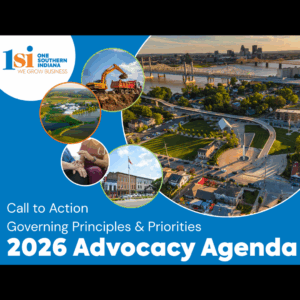
New year, new priorities! One Southern Indiana (1si) has now published our 2026 Advocacy Agenda. The release of the agenda coincides with the start of the 2026 Session of the Indiana General Assembly, which officially began. Weekly emails will begin next week to keep members up to date on legislation we are following, and that may impact you and your business. See the upcoming deadlines to keep in mind as the session moves forward. 

  • Wednesday, January 7 – Senators may file only two bills per business day beginning today 
  • Wednesday January 7 – Deadline for filing House bills not later than 2:00 p.m. 
  • Friday January 9 – Deadline for filing Senate bills not later than 4:00 p.m. 
  • Friday January 16 – Last day Senate bills may be assigned to Senate committees.

We look forward to kicking off our yearly events with the Advocacy State Leadership Breakfast, hosted at Prosser Career Education Center, and sponsored by the following organizations: 

  • Presenting Sponsor: MAC Construction 
  • Platinum Sponsor: AT&T, Baptist Health, Duke Energy, Meta 
  • Gold Sponsors: Dan Cristiani Excavating Co. Inc. and Metro United Way 
  • Silver Sponsor: Frost Brown Todd 

Thank You for Renewing Your Membership | December 2025

One Southern Indiana would like to thank the following members for renewing their membership during the month of December 2025.

Quarter Century Club (25 years or more)Member Since
PC Home Center1978
Stites & Harbison, PLLC1982
Libs Paving Co., Inc.1990
Norton Healthcare1994
Hope Southern Indiana, Inc.1998
Rock Creek Community Academy1998
  
10-24 Years 
Business Health Plus, Inc.2003
LL&A Interior Design2005
R. H. Clarkson Insurance Group2007
Peyton’s Barricade & Sign Co.2008
Mediaura2008
Dean Dorton Allen Ford, PLLC2008
FormWood Industries, Inc.2009
Kentuckiana Wood Products, Inc.2011
ATS Integrated Solutions, Inc.2013
Peyton Technical Services, LLC2013
Schimpff’s Confectionery2014
Purdue Polytechnic New Albany, Purdue University2014
A Plus Paper Shredding2014
Clarksville Strike & Spare Family Fun Center2015
  
5-9 Years 
Down Syndrome of Louisville Indiana Campus2016
King’s-Quality Restoration Services LLC2017
Tree of Life Family Birth Center2018
Gaylor Electric2018
Louisville Regional Airport Authority2018
Purple Pearl Skin & Beauty2018
Vision First Eye Care – Jeffersonville2019
Excel Excavating, Incorporated2020
J.F. Hilliard Company LLC2020
Board and You Bistro2020
  
2-4 Years 
Magnet Culture2021
Lewen Line Construction2021
KORT Physical Therapy – Madison2021
Xtreme Transportation2021
Kentuckiana Regional Planning & Development Agency (KIPDA)2021
Lead Well Strategic Consulting2022
CyberdomeUSA2022
The Villages at Historic Silvercrest2022
Zach Wedding, Realtor- Six Degrees Real Estate2022
Redemption Solar and Roofing2022
Access Justice2023
Dock Seafood Inc2023
Clark Station Shopping Center2023
Classic Truss and Wood Components, Inc.2023
Odyssey Financial Group – Travis Nicks2023
Merrick Printing Co., Inc.2023
Kim Cruises, LLC2023
stayAPT Suites Louisville North-Clarksville2023
Schindler’s Garage2023
ROOFTECH2023
  
One Year 
Clark County Youth Shelter and Family Services, Inc.2024
Primavera & Associates2024
P.U.S.H. Transportation Company LLC2024
Flats of River Ridge2024
RK Bluegrass2024
KCS Foundation and Waterproofing Specialist2024
Marco Company2024
Bass Group Real Estate2024
Idealogy Marketing + Design2024
ADE Food African Kitchen & Catering Services2024
Lumos2024
Laswell Electric Company Inc.2024

From Dot-Coms to Data Center: What Past Booms Can Teach Us About AI

submitted by Uric Dufrene, Ph.D., Sanders Chair in Business, Indiana University Southeast
 

Are there similarities between what we are seeing today with artificial intelligence, and the massive investment required to build the data-center infrastructure that supports it, and the dot-com collapse or the housing crisis that led to the Great Recession? It’s a reasonable question, and one worth examining.

To answer it, we need to go back to the late 1990s.

As the calendar approached the year 2000, companies poured billions of dollars into technology upgrades to prepare for Y2K. Dire predictions circulated about elevators failing and planes falling from the sky when the clock rolled over to January 1, 2000. None of that happened. But the investment surge was real.

At the same time, the internet was rapidly gaining traction. Businesses were building websites, consumers were beginning to shop online, and entirely new business models emerged that relied exclusively on the internet. Innovation was real, but so was speculation. Stock prices soared, especially in technology shares. The NASDAQ Composite nearly doubled between 1998 and its peak in early 2000.

When earnings and profits failed to match lofty expectations, valuations collapsed. Remember the infamous pets.com. The NASDAQ ultimately fell nearly 80% from peak to trough, contributing to the 2001 recession. It would take roughly 15 years for the index to fully recover the value lost during the dot-com implosion.

As always, investors then went searching for returns elsewhere. Capital flows to the highest rate of return, adjusting for risk.

In the mid-2000s, that search increasingly led to structured mortgage products, most notably mortgage-backed securities and collateralized debt obligations. These instruments pooled mortgage payments and passed the cash flows through to investors. Because housing prices had risen steadily for decades, these securities were widely viewed as lower risk.

Demand surged. To meet it, lenders originated more mortgages, often with weaker underwriting standards. Adjustable-rate mortgages proliferated, loan-to-value ratios climbed, and in some cases mortgages exceeded the value of the homes themselves. As long as home prices kept rising, the system appeared stable. 

That stability proved illusory. When interest rates reset higher and borrowers began missing payments, the cash flows supporting these securities deteriorated. Losses spread quickly through the financial system, triggering the 2008 financial crisis and the Great Recession, the most severe economic contraction since the Great Depression. The pets.com implosion years earlier ultimately turned into the Great Recession. 

So how does artificial intelligence fit into this historical comparison?

Once again, we are witnessing massive investment tied to transformative technology. Hundreds of billions of dollars—and potentially more than a trillion globally over the coming decade—are being invested in data centers, power infrastructure, and advanced semiconductor capacity to support AI. These investments are helping fuel equity markets, with a small group of large technology firms—the so-called “Magnificent Seven”—accounting for a disproportionate share of recent stock market gains.

As in prior cycles, leverage is playing a role. Much of this build-out is being financed with debt. While some of that debt is long-term, concerns are emerging about mismatches between financing structures and the underlying assets. Data centers may last decades, but the chips inside them often have useful lives measured in just a few years. Financing rapidly depreciating technology with long-dated debt introduces risk.

Markets have already shown sensitivity to that risk. Recently, disappointing news from a handful of AI-infrastructure firms triggered sharp reactions in equity prices. High expectations are embedded in today’s valuations, and much must go right for projected returns to materialize. Ultimately, someone must service the debt and deliver returns to capital providers.

That does not mean an AI-driven collapse is inevitable. There are important differences from past cycles. Many of today’s leading technology firms are profitable, cash-rich, and generating real revenue growth. AI is delivering tangible productivity gains, not just speculative promise.

Still, history offers a cautionary lesson. Periods of transformative innovation are often accompanied by overinvestment, financial excess, and unrealistic expectations. When returns fail to materialize as quickly or as broadly as hoped, markets adjust—sometimes abruptly.

The risk is not artificial intelligence itself. The risk lies in how aggressively it is being financed, how optimistic the assumptions have become, and whether capital discipline is maintained. History doesn’t repeat, but it often rhymes—and investors would be wise to remember that as the AI investment cycle continues to unfold.

1si Non-Profit Spotlight: New Albany Main Street

Since 1990, New Albany Main Street, a nonprofit organization, has been dedicated to revitalizing and preserving the heart of their city. From historic downtown to bustling midtown and uptown, they are committed to creating a vibrant community where residents and visitors can shop, live, play, and explore.

Watch the video to learn more about their services, or visit their website.

U.S. Chamber of Commerce Awards One Southern Indiana Chamber of Commerce and Economic Development with 4-Star Accreditation

New Albany, IN — The U.S. Chamber of Commerce has awarded One Southern Indiana Chamber of Commerce and Economic Development (1si) the prestigious Accreditation designation in recognition of its sound policies, effective organizational procedures, and significant positive impact on the community it serves. 

“Achieving the Accreditation designation is a significant accomplishment that underscores the chamber’s steadfast dedication to its community and its commitment to organizational excellence,” said Raymond P. Towle, U.S. Chamber Vice President, Federation Relations and IOM. “This prestigious recognition places the chamber among the top in the industry, showcasing its exceptional leadership, meaningful contributions, and critical role in driving growth, innovation, and opportunity within the business community.” 

Lance Allison, President and CEO of 1si, shares, “This accreditation is more than an organizational milestone, it’s a reflection of the businesses, partners, and leaders who power our region. Our team shows up every day committed to serving this community with excellence, and this reflection affirms that effort. We’re proud of the work behind us and excited for the opportunities still ahead.” 

The U.S. Chamber’s Accreditation Program sets the standard for excellence in the chamber industry, fostering a pro-business environment across the nation. To achieve Accreditation, chambers must meet high standards in areas such as governance, government affairs, communications, and technology. This comprehensive self-review process typically takes 6-9 months to complete and reflects a chamber’s dedication to continuous improvement and measurable progress. 

Local chambers are rated as Accredited, 3-Stars, 4-Stars, or 5-Stars, while state chambers are recognized as either Accredited State Chamber or Accredited State Chamber with Distinction. The final determination is made by the Accrediting Board, a committee of U.S. Chamber board members and chamber CEOs from across the country. 

This designation underscores 1si’s commitment to excellence and its role as a vital resource for the business community, fostering growth, innovation, and opportunity for its members and the region it serves. 

About One Southern Indiana 
One Southern Indiana (1si) was formed in July of 2006 as the economic development organization and chamber of commerce serving Clark and Floyd counties. 1si’s mission is to help businesses innovate and thrive in the Southern Indiana / Louisville metro area via the three pillars of Business Resources, Economic Development, and Advocacy. For more information on One Southern Indiana, visit www.1si.org.  

Contact: 
One Southern Indiana 
Ellinor Smith | Content Marketing and Media Relations Manager 
EllinorS@1si.org | 217-320-4832 

Thank You for Renewing Your Membership | November 2025

One Southern Indiana would like to thank the following members for renewing their membership during the month of November 2025.

Quarter Century Club (25 years or more)Member Since
Louisville Business First1984
Star Electric1984
PNC Bank1985
  
Ten to 24 Years 
The Spaghetti Junction2014
Seven Development, LLC d/b/a 7D Commercial Real Estate2015
  
Five to Ten Years 
Mathes Pharmacy & Homecare2016
BJB Inc.2017
ActionCoach Bluegrass2018
Rapid Industries Inc.2018
A Class Act DJ’s2018
Hagerman Inc.2019
L & N Federal Credit Union2019
Kahl’s Body Shop2019
Big O Tires – Sellersburg2020
Homeless Coalition of Southern Indiana2020
  
Two to Four Years 
Hyland, Block, & Hyland, Inc.2021
Lamar Advertising2022
The Elderberry Co.2022
Twin Interiors, Inc2022
CXE Insurance2023
BIG Solutions2023
Keller Williams Realty Southern Indiana2023
Tommy’s Express2023
  
One Year 
Mochi Wren2024
University of Louisville – J.B. Speed School of Engineering2024
Carroll Media Corp.2024
The Barber House 2024
All Star Trucking, Inc.2024
East & Westbrook Construction2024