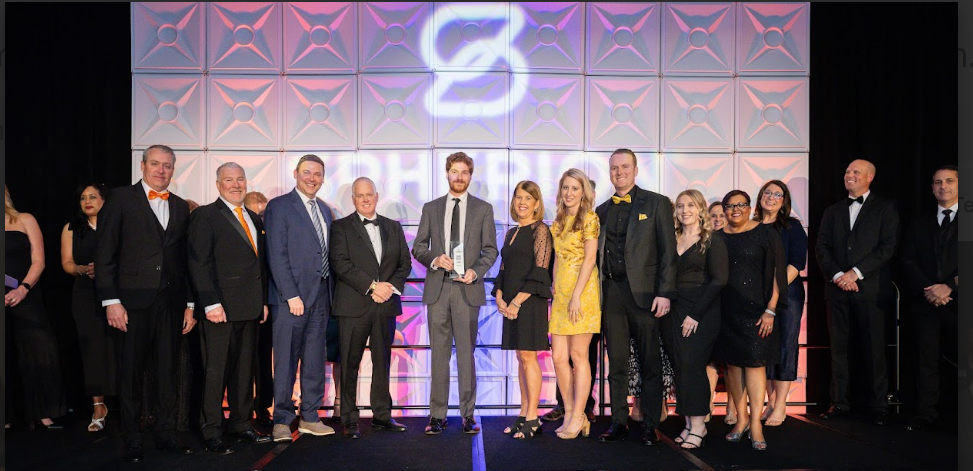
New Albany, Ind — IU Southeast School of Business students earned top honors in the recent RNMKRS sales competitions. Students in the Personal Persuasion Strategy and Customer Relations Management class participated in the competitions, with most placing in the top 30% in at least one or more of the individual events.
IU Southeast finished first in Role Play and Speed Sell. This is the second time that IU Southeast has finished first in Role Play, and the fifth time in six years in the top two. It is also the second time IU Southeast finished first in Speed Sell. The IU Southeast team has finished in the Top 3 in Speed Sell in each term it has competed. Six out of ten of the top individual scorers in the Pilot Cold Call competition were from IU Southeast.
Carter Crews earned class champion honors and finished in the Top 1% overall in both Speed Sell and Role Play. Crews also finished 6th overall and 4th in the class in the Cold Call competition.
Cassie Walls was the overall champion in Cold Call, only the second IU Southeast student to win a RNMKRS competition. (Carolyn Kannapel was the champion in Role Play for the Fall 2024 competition.) Walls also finished Top 8% in Speed Sell and Top 28% in Role Play.
Other standout finishers included:
- Sam Boston – Top 1% in Role Play, Top 2% in Speed Sell, and 10th overall in Cold Call
- Lillie Weber – Top 2% in Role Play, Top 5% in Speed Sell, 2nd overall in Cold Call
- Kiki Brown – Top 1% in Role Play, Top 2% in Speed Sell, Top 14% in Cold Call
Approximately 40 schools participated in Role Play and Speed Sell, with over 2,000 students participating in the Role Play. Cold Call was a pilot competition in which about 17 schools and 350 students participated. Other schools participating in the various competitions included IU Bloomington, Indiana State University, Boston College, Auburn University, Northern Kentucky University, Northern Illinois University, Bryant University, Purdue University Northwest, West Virginia University, Rollins College, Bowling Green State University, the University of Nebraska at Omaha, and the University of Illinois at Chicago, among others.
For the Role Play competition, students represented Dell Technologies, selling rugged notebook computers to a Texas police department’s IT Manager. The goal is to earn a second appointment to demonstrate the computers and complete the sale.
In Speed Sell, students found themselves on an elevator, pitching themselves for a job interview. They have about 90 seconds to make their case and convince the manager to stay on the elevator to listen to their entire pitch.
In Cold Call, students represented a staffing company Insight Global and made a cold call, to gain a meeting to learn more about the company, and how Insight Global might be a solutions provider for them.
Dr. Chris Cox, professor of the Personal Persuasion Strategy and Customer Relations Management course, says the event is a valuable experience for his students. The ultimate goal is not to win the competitions, Cox says, but to use RNMKRS as a tool to develop sales skills that can be applied in real-world selling scenarios.
“One of the great things about these competitions is that they allow students to develop their skills anytime, anywhere, and all by themselves, without a coach or instructor standing over their shoulder. We want them to develop ‘muscle memory’ for the sales process, so they do not have to think about it; so it comes more naturally. It helps them get down the road in their development of selling skills further and faster.”
Cox says students can role-play on the web or through apps on their phones, getting instant feedback from AI.
“Students can do dozens, even hundreds, of role plays. This kind of repetition is not possible in class, with live human role-plays. The AI characters can be challenging, both because the process itself is difficult to master and because the AI is still developing; it can be frustrating. But these students powered through, and showed a level of commitment, persistence, and problem-solving skills that not only help them overcome technical challenges, but more importantly, help them develop an understanding of the sales process that they can apply in their careers, whether in professional sales or non-sales selling scenarios.”
Students in the course are currently preparing for their final face-to-face role-play in the class. Cox says he is looking forward to seeing them apply what they’ve learned.
###
About IU Southeast: IU Southeast is one of nine campuses of Indiana University. Offering top-quality and nationally accredited programs in education, nursing, business, social sciences, natural sciences, arts and humanities, the scenic 180-acre campus is located less than 15 minutes from downtown Louisville, Kentucky. It currently has over 3,750 students and employs over 360 faculty members. About 400 students live on campus in five fully furnished, lodge-style residence halls. Through an agreement with the Commonwealth of Kentucky, Indiana University Southeast offers in-state tuition to students enrolled from ten counties in the Louisville region, including Bullitt, Hardin, Henry, Jefferson, Meade, Nelson, Oldham, Shelby, Trimble, and Spencer counties and discounted tuition for remaining Kentucky residents through the Indiana Partner Program. For more information, visit https://southeast.iu.edu. IU Southeast is a tobacco-free campus.
Contact: Nancy Jo Trafton
812-941-2676
ntrafton@ius.edu